Bravo Solutions Stories: Office Optional, Hospitality Required
- by Ally Padrick

Executive Chef Juan Pablo Galeano prepares to welcome diners for a special event at a technology company.
Bon Appétit teams meet the hybrid moment in many ways
The phrase “return to office” has become something of a corporate bogeyman — dreaded by employees, debated by leadership, and tied to broader questions about culture and engagement. In the era of hybrid work, office life has a different rhythm, one that flexes by the week, the team, even the weather.
For many of the guests we serve, this flexibility is part of the appeal of their workplace. But it also means our food programs must do something they were never quite built for: shift seamlessly from 100 guests to 700, often multiple times a week.
This challenge can feel daunting. But it also offers a chance to work collaboratively with clients to realign both goals and definitions of success. Across our accounts, operators are finding creative, strategic ways to adapt, not just to survive in a hybrid world, but to thrive in it.
Guest counts used to follow a predictable pattern. Not anymore. While some clients now mandate specific in-office days, others leave attendance entirely up to employees. That leaves our teams planning meals for unpredictable headcounts with labor, quality, and guest satisfaction still expected to hold steady. “We’ve seen a clear difference in how people are planning their days,” says Director of Dining Services Natalie Foster.
Shifting Strategies for Fluctuating Populations
At one large, multi-site technology company in the San Francisco Bay Area, the team navigates two very different settings: a large, full-service campus that supports up to 3,000 people, and a much smaller downtown headquarters location where the same standards are expected despite far fewer resources. When considering fluctuating populations, many think of the doldrums of service, where customers trickle in. But this team had to think quickly to scale up services to match unanticipated high-attendance days, not only to feed more people but to mitigate bottlenecks in busy areas.
One solution to re-orient people in crowded spaces? They rolled out a soft serve ice cream program in quieter buildings, mirroring a hit amenity from headquarters. “It created buzz, helped spread foot traffic, and gave us an unexpected revenue boost,” says Director of Operations Michael Bear. “It also let us relieve pressure from pinch points without compromising experience.”
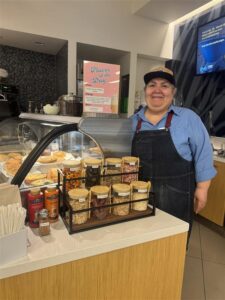
Barista Brenda Salazar welcoming guests to a bountiful soft-serve station at a tech company in Northern California.
A California-based social media company successfully embraced flexibility, especially on slower days. The team implemented a Friday brunch service that spans both breakfast and lunch windows. Guests love it, and it allows the culinary team to use saved staff time for prep and cleaning tasks, using labor hours more efficiently. And when a scheduled influx of employees from another location showed up for an all-hands meeting, the team responded by offering a second brunch window to accommodate the spike — a small shift that made a big impact.
As the on-site team’s Vice President of Client Relations Andrew Znidarsic puts it, “While we continue to focus on serving great food, we also appreciate the need to present our program in a way that makes people feel good about coming in.”
Scaling Smarter
At another corporate account in the area, when the client merged services to fewer vendors, a bold, system-wide approach was needed. Fewer vendors meant Bon Appétit’s scope increased from four to 10 locations under this new, shared program. While challenging, the increase in volume and client-side consolidation effort streamlined both labor and food costs. Serving more locations revealed multiple efficiencies in categories like labor, food cost, and other controllable and non-controllable expenses, reducing the overall cost per person per day by seven percent, says the account’s National Director of Operations Scott MacGowan.
In addition to built-in flexibility from a larger team (like absorbing issues such as callouts and shift changes), an unforeseen benefit to quickly scaling was “watching our team grow, learn, and see what people were truly capable of,” says Culinary Director Kirk Raschhuber Moore.
Partnering for Greater Impact
And while we always celebrate homegrown solutions to widespread challenges, Compass Group can play an important supporting role. One CA-based creative firm, for instance, has embraced every facet of a data-driven program offered by Compass. In partnership with the client, the team has added a dedicated, senior E15 analyst to the portfolio. E15 helps accounts like this turn feedback and operations data into smarter program design.
The results speak volumes: a 10% reduction in total costs, 8% higher check averages, and the highest guest satisfaction scores on record. Participation now regularly tops 100%, as employees engage with multiple touchpoints throughout the day. Adobe hasn’t raised prices since 2012, yet the program remains financially strong –proof that good data paired with smart strategies can stretch resources further than expected.
The Foundation: Trust and Transparency
Between client and teams, a shared commitment to partnership connects these efforts. Operators aren’t just responding to client requests; they’re working alongside clients to shape the strategy itself. Whether through alignment exercises, detailed dashboards, or creative event planning, teams are building trust by being transparent about tradeoffs and outcomes. This collaborative spirit is part of our ethos and is mirrored by our clients. As MacGowan put it, when Bon Appétit introduced a commissary program out of his client’s kitchen that saved the client money through shared cost and menu synergies, “the client didn’t just want to realize the savings — they wanted to reinvest it to make the program even better.”
We may not be able to control how many people come to the office on any given day. But we can control how they experience it. Across Bon Appétit, our teams are showing what it means to stay nimble, imaginative, and people-first.