But every once in a while, something brings all of that into much sharper focus. For me, that moment happened recently in Cà Mau, Vietnam. While visiting shrimp farms there, I found myself standing between two operations less than a kilometer apart. On paper, they existed in the same place. On the ground, they couldn’t have been more different.
The first farm was built around efficiency. Large ponds were carved into the land and lined with plastic. Paddle wheels turned constantly to aerate the water. Everything about this farm was engineered for output and consistency. But it felt empty. There were no birds overhead, no trees, no sense of anything beyond the mechanics of production.
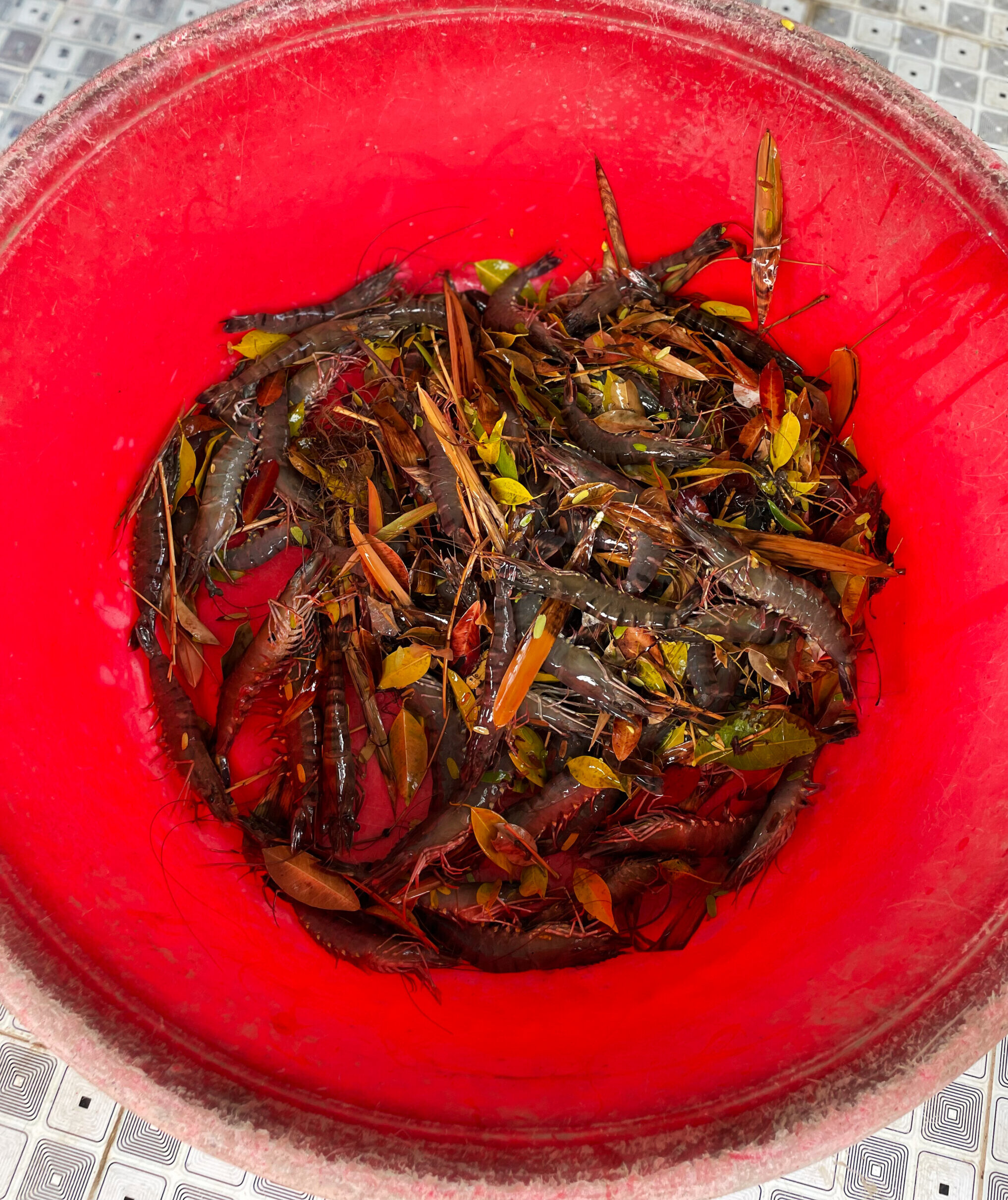
Not far away, the second farm told a completely different story. It was situated within a mangrove forest, shaded by a dense canopy of trees. You could hear the water moving naturally with the tide. Even the ground felt alive. This wasn’t a system forcing production; it was working with the environment around it.
The farmer, Phạm Thanh Tuấn, explained that he raises shrimp the same way his family has for generations. No chemicals, no added feed. Just the tidal system, the mangroves, and time. The shrimp grows as part of that ecosystem, rather than apart from it. The contrast was hard to ignore. Two farms, two fundamentally different approaches to how we produce food.
The Reality of Shrimp Farming
What I saw in Vietnam reflects a much bigger reality. A significant portion of the shrimp that ends up on U.S. plates comes from small-scale farms across South and Southeast Asia. These farmers are essential to the global supply chain, but many haven’t had a clear way to demonstrate how they operate or improve their practices. For a long time, the system hasn’t worked in their favor. Sustainability ratings are often applied broadly at the country level, which doesn’t capture what’s happening on individual farms. Certification programs can be expensive and complicated, putting them out of reach for many small producers. As a result, farmers who are doing things responsibly haven’t always had the ability to prove it or benefit from it. That disconnect is starting to change.
Helping Farmers Shift Their Practices
While I was there, I was encouraged to learn about the development of new tools designed specifically for these farmers, like the Monterey Bay Aquarium’s Verification Platform. It gives farmers a practical way to measure their operations against established sustainability standards using something as simple as a tablet or smartphone.
More importantly, the verification platform helps farmers identify where they can improve and gives them a credible way to show buyers how they perform. For farmers who have been doing the right thing all along, it opens the door to markets that finally recognize and reward those efforts. From my perspective, that’s a big shift. It makes it possible for more producers to meet the standards and benefit in the marketplace as a result.
Better Systems = Better Flavor
Back in the kitchen, this process shows up in ways you can’t ignore. Shrimp raised in a natural mangrove system cook differently compared to shrimp from intensive systems. They hold their structure in the pan. The texture is firm, and the flavor carries a clean, slightly sweet depth that doesn’t disappear, reflecting the environment where they were raised.
After spending years in kitchens, restaurants, large-scale operations, teaching, and now culinary purchasing, I have a solid understanding of how much sourcing matters. But seeing it firsthand like this brings a different level of clarity. Especially when you consider economies of scale. The decisions we make don’t just impact a single plate. They influence supply chains that move millions of pounds of product every year. Those choices either support systems that restore and sustain, or systems that deplete.
That’s what stuck with me the most coming back from Vietnam. Sustainability isn’t something abstract. It’s not just a policy or a goal. It’s something you can see, smell, hear, and stand in. It exists in ecosystems like those mangrove forests, and in the communities that depend on them.
And in a very real way, we help shape what gets farmed by what we choose to buy and serve. The good news is, a better system already exists. We saw it. The challenge now is making sure more of our decisions support it.
Patrick is an Executive Chef and Senior Purchasing Manager at Bon Appétit. He recently joined the Monterey Bay Aquarium’s Blue Ribbon Task Force, a group of chefs who advocate for sustainable seafood.