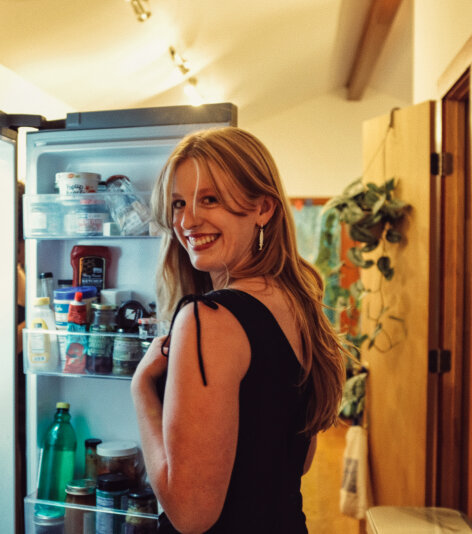
Dawn obliged, even offering the student a bottle to keep in her room. The young woman was so pleased, notes Dawn, that when she became a student tour guide, the episode became one of her go-to stories to share with prospective students. “Small touches have traction,” Dawn says.
Safely serving guests with dietary restrictions — including allergies and food intolerances and sensitivities — while maintaining our high standards of hospitality is a priority (and a balancing act) for every operator at Bon Appétit Management Company. Minimizing allergen exposure carries a great deal of weight, and operators must also consider the dietary requirements of different religious groups, vegans and vegetarians, and global guests who are seeking an authentic taste of home. It’s a tall order.
But it’s one that, by following protocol and integrating hospitality with compliance, many teams are fulfilling. “Transparency and accuracy are a form of hospitality,” says Terri Brownlee, MPH, RD, LDN, vice president of food education and wellness. “We need to create a space where all are welcome, and they can find foods that meet their dietary needs.”
Our operators work hard to create inclusive menus that welcoming for all — especially guests with allergies and special diets. Here are some best practices they shared:
“Transparency and accuracy are a form of hospitality. We need to create a space where all are welcome, and they can find foods that meet their dietary needs.” - Terri Brownlee, MPH, RD, LDN, vice president of food education and wellness.
Allergen Management:
Personalized outreach: At Case Western Reserve University in Cleveland, OH, Senior Wellness Coordinator Leilah Absi, MS, RD, LD, makes a point of getting ahead of the students with food allergies. “I try to advertise myself and get myself out there as much as possible, especially in the beginning of the school year,” she says. “I go to orientation fairs, I set up Meet the Dietitian tables in the dining halls, and I try and catch students and introduce myself to students who may have an allergy and didn’t even know a dietitian was on the campus. I do as much as I can to find students who need that help.”
Pro-active planning and communication: At Adobe’s locations in San Francisco, Nutrition Programs Manager Madeline McDonough, MS, RD, LDN, and Enterprise Senior Executive Chef Erik Akers have worked closely to build a thorough system for allergen management, says Madeline. They’ve worked to embed food safety into the team culture by weaving related messages throughout their messaging and emphasizing planning and communication.
“Our standard is pretty high,” she says. “We focus on being pro-active instead of reactive, and when it comes to allergen [management] that’s super important.”
To that end, the chefs create menus two weeks out. “Getting ahead of it two weeks has been super helpful in communicating with the chefs, so they have time to be innovative and creative, but they’re also still keeping safety at the top of their priorities,” says Madeline.
Encouraging open communication has also been key, says Erik. “We focus on building trust with the teams so that if something does change, they can reach out to Madeline or me and ask us to look over the menu,” he says. “That’s something that’s just system-wide, and there’s a lot of trust built into the process,” he says.
Special Diets

Collaboration is key: At Penn Dining, the team is always tracking the needs of their global student body and creating programs to fit their needs, often in partnership with other entities on campus. “Collaborations are the key component to every program that we do,” says Sarah Goff, wellness manager at Penn, “because they inform us on how we can meet students where they are and create programs that are really meaningful.”
For example, the Falk Dining Café on campus makes fully glatt kosher meals (including those for Passover) available to Penn’s Jewish students in partnership with Penn Hillel, a Jewish community organization on campus. Similarly, in partnership with Penn’s Muslim Students Association, Kings Court English House is Penn Dining’s dedicated Halal café. English House serves only certified Halal meats while completely avoiding pork and cooking alcohol.
Additionally, Penn’s new Global Gardens station is one of the first in the country to offer menus in accordance with Jain dietary principles. It was planned and launched in collaboration with the university’s Office of the Chaplain and the student-run Hindu & Jain Association, who provided guidance on Jain diets as well as traditional foods and preferences. Penn Dining then created a dynamic program to meet students’ needs for Jain cuisine and broaden the campus’s plant-forward movement by featuring global cuisines that put plants at the center of the plate.
And the team has recently piloted a new way to serve students with gluten intolerances. Their Made Without Gluten-Containing Ingredients (MWG-CI) self-serve pantries were planned in collaboration with students who were asking for versions of comfort foods, like pizza, burritos, and soup dumplings, that were safe for those avoiding gluten. Sarah surveys the students throughout the school year to maintain satisfaction and keep the rotation fresh.
While the number of students who use the pantry is relatively small, it has a big impact, says Sarah. “I’ll get feedback from students saying how they really appreciate having somewhere that feels very safe and having that peace of mind has been really important for them.”
Authentic Cuisines
Be pro-active and responsive: At Emerson, the team serves a student population from all over the world, many of whom are looking for meals that will remind them of home. The team themselves come from diverse backgrounds and love sharing their own cuisines with students, says Dawn. Together, she says, “we just embrace the diversity of it all.” To that end, they’ve prioritized community input and responsiveness. Dawn surveys students when planning station changes and has a comment board in the café where students can add ideas.
“I look at that board seven times a day,” she says. “The chef looks at it seven times a day. Whatever we see up there, we try and get it on the menu within a week or so,” she says, noting that this level of responsiveness helps build satisfaction and trust with students.
Above all, get embedded in the community: Being accessible to guests is a huge part of building trust and community, says Dawn at Emerson. “We look at the community as a whole,” when planning menus and events, she says. Whether intimate sit-down dinners for students with food allergies, making a special meal for a student, or turning around special requests quickly, Dawn is always reminding her team and reassuring guests (and their parents) of their core principle.
“The number one thing is that we’re here for the students, right? We’re taking care of someone else’s kids for nine months out of the year. Think about your own kids — you would want someone doing the same.”