During my first year, I encountered examples of education beyond the classroom that demonstrate how sustainability learning can be interactive, place-based, and community-oriented.
Food education is a core value at Bon Appétit. We are guided by four pillars: building culinary confidence, nourishing well-being, embracing sustainability, and fostering community. These pillars guide our interactions with the communities we serve, but we are also inspired by the sustainability practices we see on our campus communities.
Two examples of alternative education practices that I was lucky enough to participate in this year are the banana circles at Eckerd College and the Educational Garden Project at Emory University. Both projects embody our core pillars and have influenced my understanding and approach to sustainability education.
Hands-On Food and Sustainability Learning
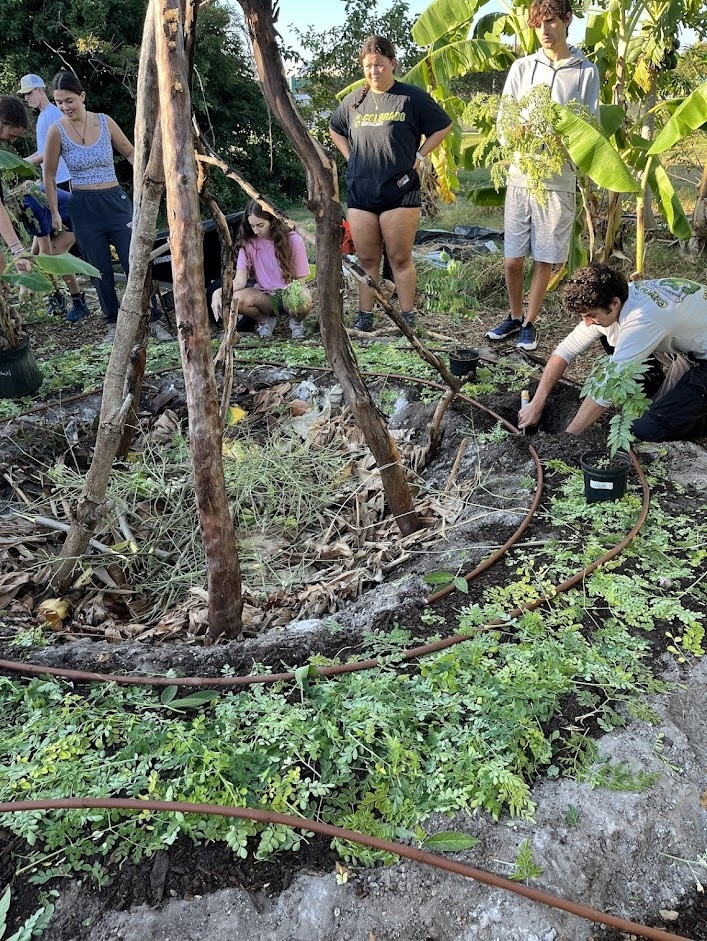
At Eckerd College in St. Petersburg, FL, I joined a Food and Sustainability class for planting day in their semester-long banana circle project. Banana circles are a traditional permaculture method originating from Africa designed to maximize water retention and nutrient access. Organic matter is placed in the compost hole in the center of a circular raised bed. On the raised bed, bananas are planted alongside a mix of tropical or subtropical plants, including cassava, lemongrass, sweet potato, and taro.
While students had been preparing for months, I was lucky enough to visit on planting day. As some students got started with planting, I was assigned the task of trimming lemongrass. Lemongrass grows in bushes with long, sturdy leaves that serve many functions, but for this task they made great mulch.
Banana circles follow the permaculture concept of stacking functions, which encourages every element of the garden to serve multiple roles. For instance, the compost pile collects water for the plants, provides nutrients, and filters water. Every plant in the circle supports the others, creating a resilient ecosystem vital to Florida’s coastal subtropical environment.
Despite being hit by several hurricanes in recent years, these banana circles have largely survived. The circles are encouraging students to reimagine the potential of their environment using traditional methods.
Cultivating Community with Small-Scale Urban Gardening
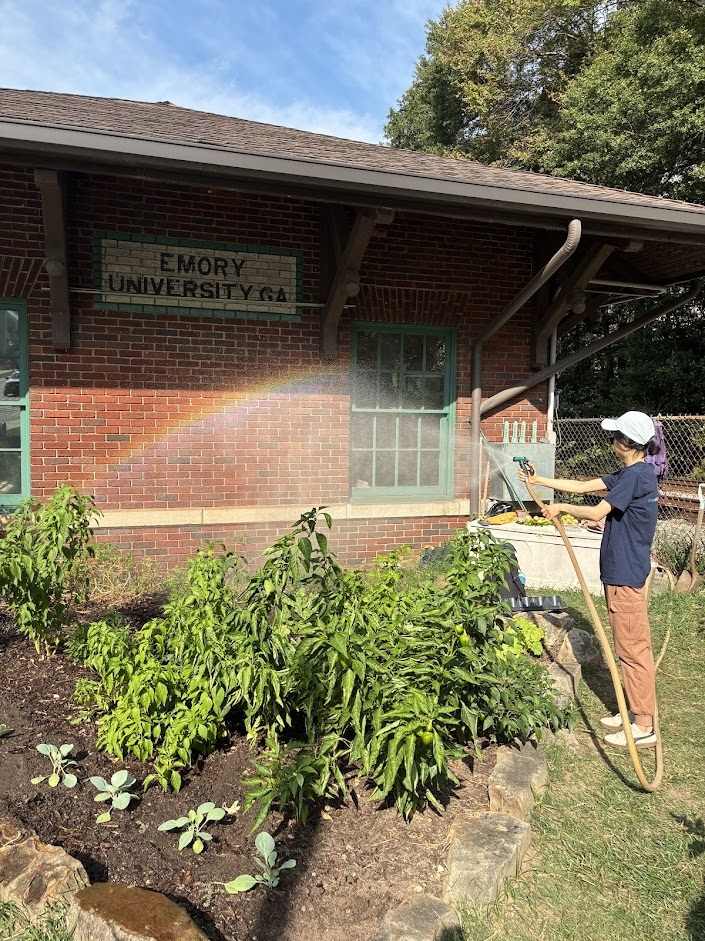
At Emory University in Atlanta, GA, I encountered a different, yet equally compelling, approach to sustainability education. Unlike Eckerd’s coastal campus, Emory operates within a largely urban environment with limited space for agriculture. Rather than seeing this as a barrier, the university’s Educational Garden Project has utilized smaller spaces that allow for garden access across campus.
At Emory University, I encountered a different, yet equally compelling approach to sustainability education. Unlike Eckerd’s coastal campus, Emory operates within a largely urban environment with limited space for ag. Rather than seeing this as a barrier, the university’s Educational Garden Project has utilized smaller spaces that allow for garden access across campus.
The Educational Garden Project emphasizes participation over production. Anyone who contributes at least one hour of work is welcome to harvest produce to take home. Students gain hands-on experience while also developing a deeper understanding of the value of volunteered labor for community benefit, and the local seasonality of Georgia. One out-of-state student told me as she became familiar with the plants in the garden, she felt more belonging in Atlanta.
The adaptability of the project was impressive, demonstrating that in a dense urban campus environment, sustainability initiatives can thrive even within physical limitations. Gardening is reframed as something accessible and communal rather than individual plots necessitating large spaces.
As a fellow, in every new community I visit, I’ve seen that students are deeply curious about where their food comes from and how food systems operate. Community gardens, workshops, and experiential learning projects create spaces where students can engage directly with sustainability and food systems in meaningful and memorable ways.
These experiences have reinforced my belief that education outside the classroom is essential to building sustainable food systems. Whether through a hurricane-resilient banana circle in Florida or an urban educational garden in Atlanta, these projects demonstrate the creativity and ingenuity already flourishing on the campuses where Bon Appétit operates.